Trusted Agentic AI
Addressing governance, safety, and sovereignty challenges of increasingly autonomous systems — from evaluation frameworks to regulatory trends.
Key Topics
Dark Factory governance: who guarantees trust when 100% of code is AI-generated?
Three pillars: Spec governance, Agent trust & identity, Provenance
EU AI Act compliance and regulatory frameworks
Sovereign AI models and evaluation frameworks
Accountability in multi-agent systems
Transparency and explainability requirements
Risk assessment methodologies for agentic AI
International cooperation on AI governance
Panel 3 · At a glance
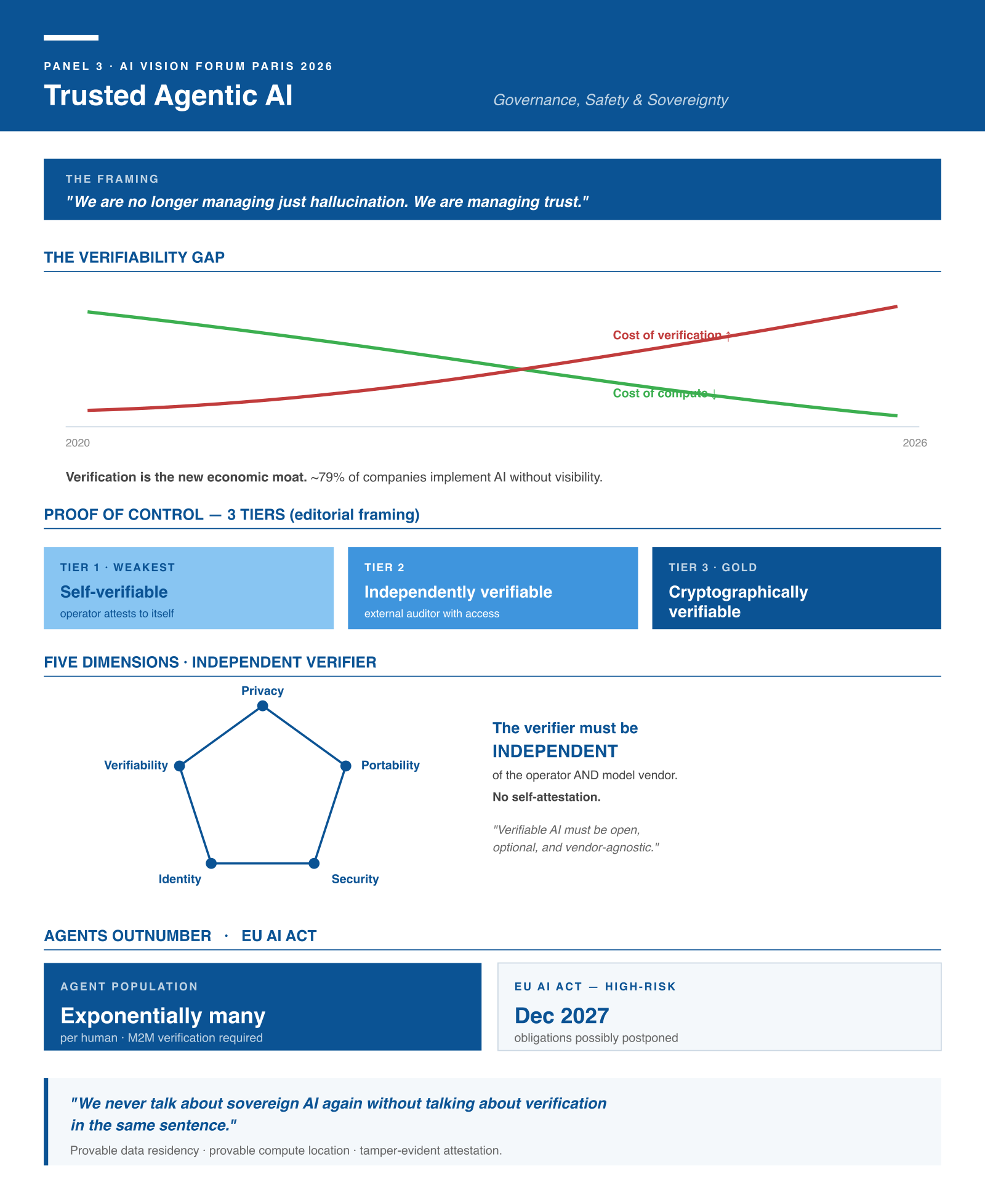
Visual summary of Trusted Agentic AI: Governance, Safety & Sovereignty.
What the discussion produced
Proof of Control in three tiers. Five dimensions of verification. Sovereign AI paired with cryptographic verification — or not at all. The EU AI Act under agentic stress: high-risk obligations possibly Dec 2027. Verification as the new economic moat.
Recommendations
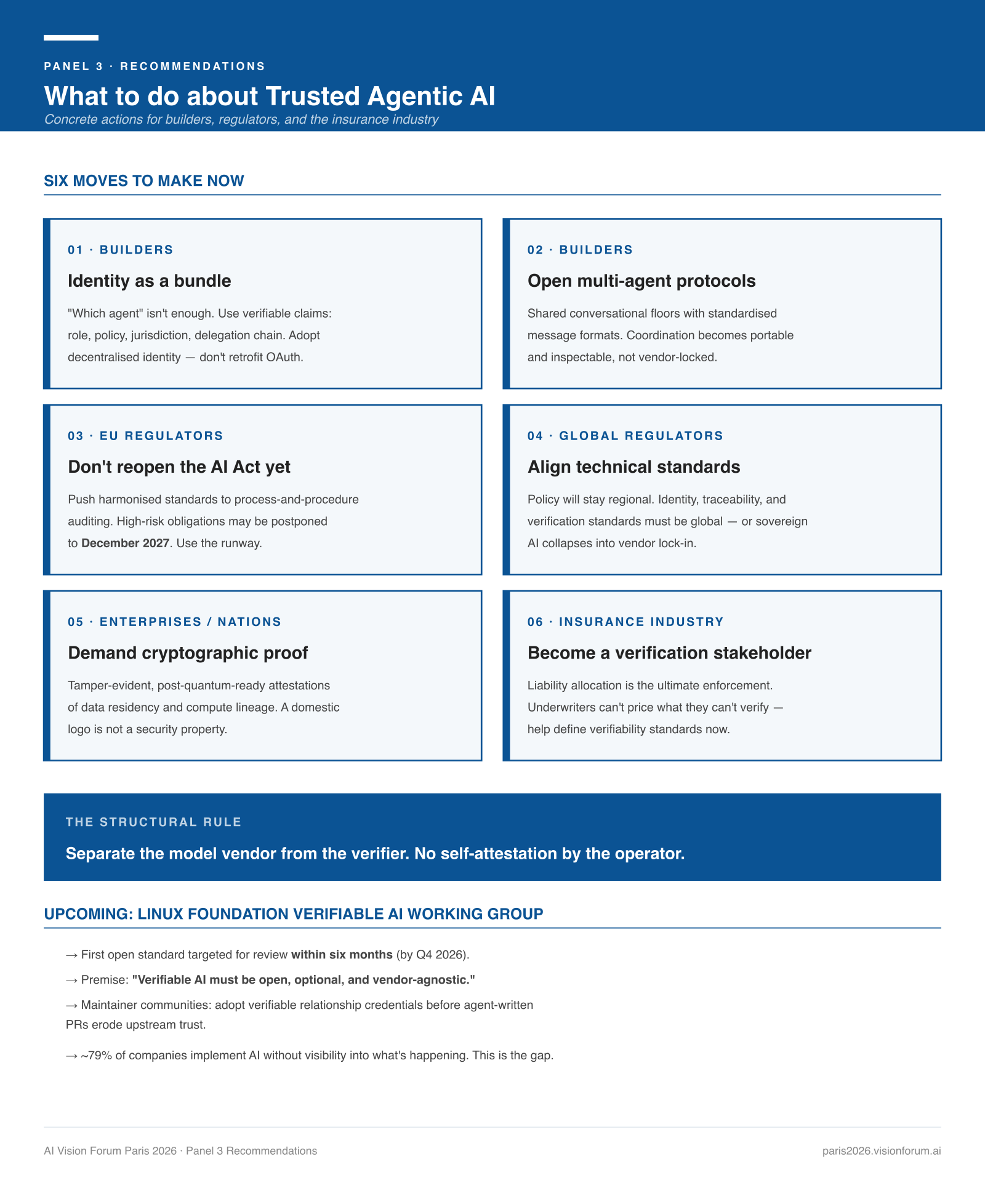
Concrete actions surfaced by the panel — distributable as a standalone card.
Three Pillars of Trust
Trusted Agentic AI rests on three pillars: Spec governance (ensuring intent is faithfully translated), Agent trust & identity (authentication and capability certification), and Provenance (tracking the origin and lineage of AI-generated artifacts). This track brings together policymakers, technologists, and civil society to address these challenges.
Practical Outcomes
- Frameworks for spec governance and agent trust & identity
- EU AI Act compliance strategies for agentic systems
- Sovereign AI model evaluation and certification approaches
- Network with regulators and compliance experts
Related Resources
Read the full forum report
Five high-conviction claims, seven headline findings, and the Paris Initiative — alongside every panel writeup.
Open the report